
Uneven Ride? Rolls-Royce Suspension and Alignment in UAE
In the United Arab Emirates, a Rolls-Royce owner may notice a change in ride height, a less settled feel, or a steering wheel that no longer sits as expected. These signs can raise questions about Rolls-Royce suspension repair and wheel alignment. The two systems are related, but they do different jobs, and one symptom does not prove that both need work.
A careful assessment starts by identifying what has changed and checking the vehicle before recommending a repair or alignment. That distinction matters on local journeys, whether the car is being driven through Sharjah, travelling between Sharjah and Dubai, or negotiating parking ramps and speed humps. Smart Garage UAE’s Sharjah-based workshop provides air suspension repairs and wheel alignment, with checks guided by the vehicle and the technician’s findings.
How Rolls-Royce suspension repair differs from wheel alignment
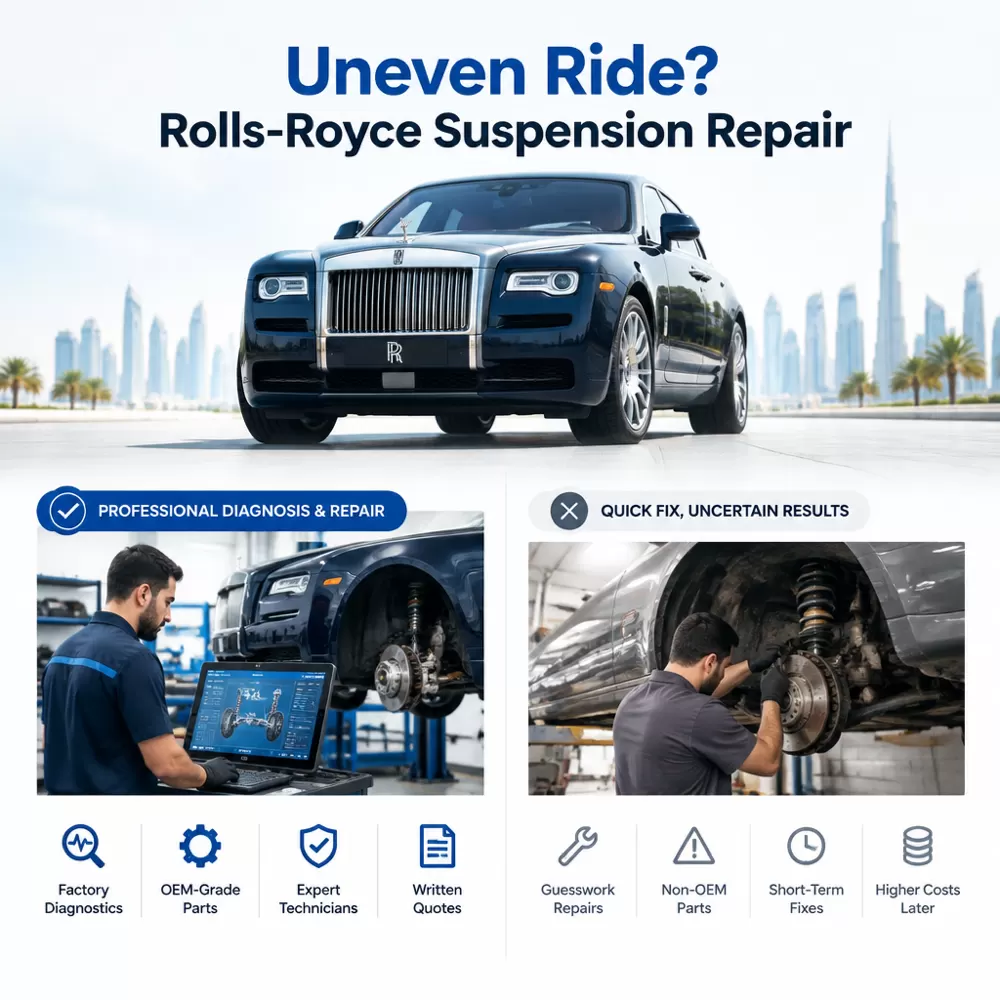
The suspension supports the car, manages the movement of its wheels and helps maintain a controlled, comfortable ride. On a Rolls-Royce equipped with air suspension, air springs and related components help support the vehicle at the intended ride height. The system also includes other parts that allow the wheels to move while the body remains composed. The exact design and diagnostic steps depend on the model and its equipment.
A suspension concern can show up as one corner sitting lower than expected, a change in how the vehicle responds over an uneven surface, or a warning message. These are observations, not diagnoses. A low corner, for example, may lead a technician to inspect the air suspension system, its connections and associated components. A warning should also be interpreted using appropriate diagnostic checks rather than guessed at from the message alone.
Wheel alignment is different. It refers to the measured angles of the wheels relative to the vehicle and to each other. Those angles affect how the tyres meet the road and how the vehicle tracks. An alignment check compares the readings with the vehicle’s specified settings. It does not inspect or repair an air spring, restore a failing suspension component, or explain every change in ride quality.
This is why the two checks should not be treated as interchangeable. If a mechanical or air suspension fault is present, an alignment adjustment cannot repair it. Equally, a suspension concern does not automatically mean that the wheel angles are outside specification. The technician needs to establish what the signs point to before deciding whether either service, or both, are appropriate.
It helps to describe the symptoms precisely when booking an assessment. Note whether the car appears lower when parked, whether the change is on one side or at both ends, and whether the concern happens consistently or only in particular conditions. If the steering feels different, say whether the wheel is off-centre while driving straight or whether the vehicle seems to drift. These details help direct the inspection, but they do not replace it.
Owners can also distinguish a visible change from a driving impression. A vehicle that looks uneven on a sloped parking surface may not be sitting unevenly on level ground. Likewise, the steering wheel’s position can be affected by how the vehicle is parked. If possible, report what you observed on a level surface and whether the condition persisted after restarting or moving the car. Avoid repeatedly testing a vehicle that feels unsafe or behaves unpredictably.
For a useful assessment, ask the workshop to explain which findings relate to suspension condition and which relate to alignment readings. A clear explanation should connect each recommendation to an inspection result. This is more useful than an assumption that a single symptom necessarily requires a particular repair.
When a technician may assess suspension and alignment together
A technician may consider both systems when the reported signs overlap. For example, if the vehicle’s ride height appears uneven and the steering also feels out of its usual position, the suspension and the alignment may both warrant attention. That does not mean both have failed. It means the symptoms should be assessed in context so the next step is based on evidence rather than on the assumption that one caused the other.
The sequence matters. If the inspection identifies a suspension fault that affects the vehicle’s position or the relationship between its wheels and body, the technician may need to address that fault before taking meaningful alignment readings. Measurements made while a relevant component is not functioning as intended may not provide a sound basis for an adjustment. The technician should explain whether the vehicle is in a suitable condition for an alignment check and why.
There are also cases where a suspension concern and an alignment concern may be separate. A change in steering position or tracking can prompt an alignment assessment, while a ride-height or warning concern may call for suspension diagnosis. A technician should look at each finding on its own merits. If alignment readings are within the applicable specification, there may be no reason to adjust them, even if a separate suspension repair is needed.
Owners arranging a Rolls-Royce suspension assessment may learn more about the technical and financial factors that can be involved. The key point for an inspection is still the individual vehicle’s condition: the model, its equipment, the symptoms and the diagnostic findings all inform what work is justified.
At a Sharjah workshop, a practical assessment can begin with the owner’s description and a visual check of the vehicle’s stance. The technician can then determine which diagnostic steps are appropriate for the Rolls-Royce and its air suspension system. If wheel alignment is being considered, the workshop can explain whether it should be measured at that stage or after any relevant suspension work. Smart Garage UAE provides both air suspension repairs and wheel alignment from its Sharjah-based premium technical workshop.
There are limits to what a brief visual check can establish. A car can appear level while still having a fault that requires diagnosis, and an unusual feel on the road does not by itself identify a particular component. A careful process may therefore involve more than one check. The technician should be able to distinguish what has been confirmed from what remains a possibility.
Local driving conditions are useful context, not proof of a fault. A route that includes ramps, speed humps, uneven road surfaces or frequent stop-start traffic may help an owner describe when a change is noticeable. But those details do not establish that the suspension is damaged or that alignment is required. Tell the technician where and when the symptom occurs, then let the inspection determine its significance.
After any recommended repair, ask whether a further alignment measurement is appropriate for the work performed and the vehicle’s condition. It is not automatically required after every suspension repair. The decision should be based on the components involved, the manufacturer’s relevant procedure and the technician’s assessment. If alignment is not recommended, ask what finding supports that decision. If it is recommended, ask for the readings and the reason for adjustment.
What to ask when arranging a Rolls-Royce suspension assessment
A short, specific conversation when booking can help the workshop prepare. Describe the change without trying to name the failed part. For instance, say that one side appears lower after the car has been parked, or that the steering wheel sits differently when driving straight. Include when the concern began, whether it is constant, and whether a warning appeared. If the vehicle’s stance changes between visits or after it has been parked, mention that too.
When speaking with the workshop, useful questions include:
- Which checks will you carry out to assess the air suspension concern?
- Will you record any diagnostic messages or measurements before recommending work?
- What findings would make a wheel alignment check relevant in this case?
- Does the vehicle need a suspension repair before alignment can be measured reliably?
- If alignment is not required, what supports that decision?
- Can you provide a written quote that separates the diagnosis, proposed repair and any alignment work?
These questions are not a substitute for the technician’s judgement. They help make the reasoning visible. A useful explanation should identify what was checked, what was found and how each proposed step relates to the reported concern. If the assessment has not confirmed a suspected fault, the quote should not present it as certain.
Before approving work, check that the written quote describes the recommended repair clearly and distinguishes it from optional or conditional work. Ask which parts are proposed and whether OEM parts are available or recommended for the repair. The right parts and procedure depend on the vehicle. A workshop should explain the options and pricing plainly rather than implying that every part or adjustment is automatically necessary.
After the work, ask for a summary of what was completed and what was verified. If a suspension repair was carried out, the explanation should say how the technician checked the relevant function. If alignment was also measured or adjusted, request the readings or report where available. If it was not carried out, the technician can explain why it was not indicated. These details give the owner a clear record without treating alignment as a routine add-on.
There are situations where it is better not to continue driving until the car has been assessed. If the vehicle is visibly sitting very low, a warning is accompanied by a pronounced change in behaviour, or the car feels difficult to control, arrange specialist advice rather than attempting to diagnose it on the road. This is a cautious response to an uncertain mechanical condition, not a prediction that a specific part has failed.
For UAE owners, choosing a workshop means looking for a process that fits a Rolls-Royce rather than relying on a generic explanation. Ask whether the team can assess the air suspension system, explain the findings in accessible language and provide a written quote before work proceeds. If both suspension and alignment are discussed, the recommendation should make clear why each check is relevant to this vehicle.
The practical takeaway is straightforward: suspension condition and wheel alignment can be connected, but neither diagnosis should be assumed from the other. Describe the symptoms, request a vehicle-specific assessment and ask what evidence supports each recommendation. That approach helps separate an air suspension fault from an alignment issue and makes it easier to decide what work, if any, is appropriate.